
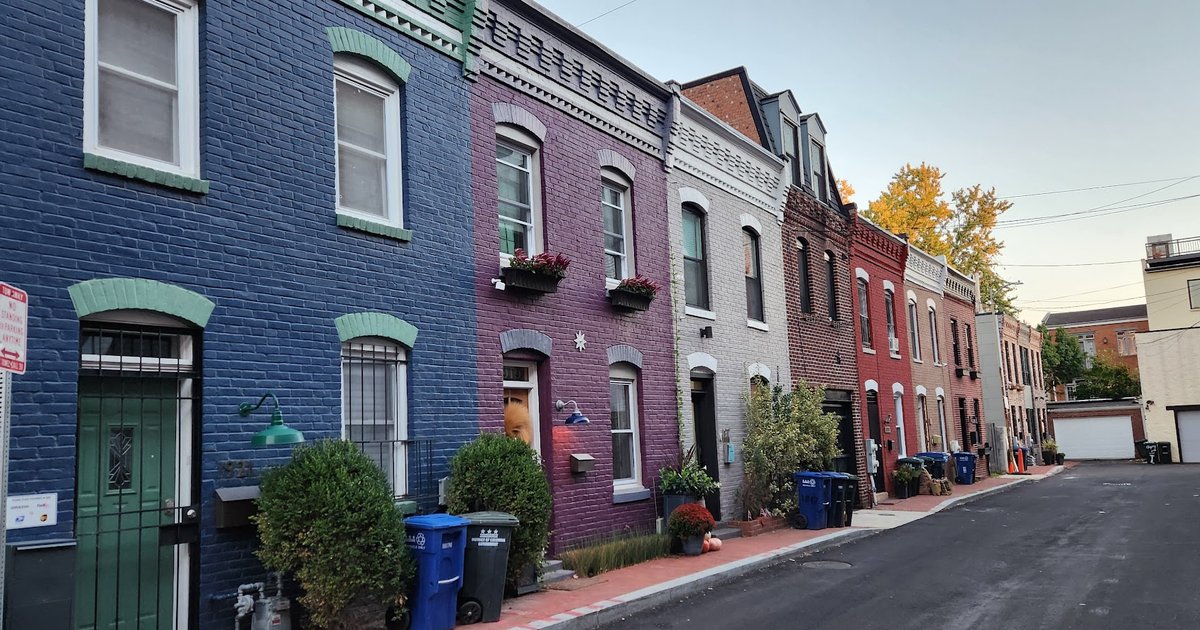
DC faces a housing shortage of 100,000 homes. Our housing supply has been constrained for decades by exclusionary zoning that limits new home construction in high-opportunity neighborhoods.
DC is rewriting the Comprehensive Plan, our city’s long‑range roadmap for growth. The Comp Plan sets policy that guides zoning and determines where we build new housing, grow jobs, connect neighborhoods, and invest in amenities. The new Comp Plan will be in effect through 2050. This is our best chance to build more homes in DC and bring down the cost of housing.
DC YIMBYs has developed policy priorities for the Comprehensive Plan. If you're giving feedback to the Office of Planning or elected officials, ask for these items to be included in the next Comprehensive Plan. To learn more about how to give feedback, visit the Office of Planning's website for the Comprehensive Plan.
- Legalize up to Six Homes on All Residential Lots: Allow small apartments citywide.
- Allow Parking Flexibility Citywide: Eliminate burdensome parking mandates and give homebuilders and local businesses the flexibility to determine parking based on their site and neighborhood needs.
- Promote Transit Oriented Development: Allow buildings up to the height limit within ½ mile of Metro stations and ¼ mile of high-frequency bus lines.
- Reduce Minimum Lot Sizes and Widths: Legalize starter homes by removing burdensome, exclusionary lot size requirements.
- Expand Lot Coverage Allowances: Increase allowable lot coverage to at least 70% in residential zones and 80% in RA-3 and higher density apartment zones.
- Reduce Setback Requirements: Eliminate side setbacks to legalize rowhomes city-wide. Reduce front and rear setback requirements to provide more usable building area on residential lots.
- End Floor Area Ratio (FAR) Mandates: Eliminate FAR limits to enable flexible and efficient land use.
- Eliminate Unnecessary Barriers to In-Law Suites: Allow homeowners to build in-law suites, providing affordable options to renters and allowing loved ones to age in place.
- Allow Apartments By-Right on Industrial Land: Allow residential apartment buildings by-right on all land zoned for Production, Distribution, and Repair (PDR).
Want more information on the issue, our proposed changes, or how these reforms have worked in other cities? You can find detailed write-ups for each of them below!
Issue
DC bans duplexes, fourplexes, and apartments on most residential land. This severely limits housing options and creates increased competition for homes, drives prices up, and displaces working families. Historically, white and high-income neighborhoods have used zoning rules to limit racial integration, and today those laws continue to limit economic opportunity.
What Does the Zoning Code/Comp Plan Say Now?
Nearly 60% of DC’s residential land bans duplexes, fourplexes, and apartments. In high-income neighborhoods west of Rock Creek Park, 77% of residential land mandates these restrictions.
Proposed Change
Allow six units by-right on all residential parcels. Works best if we also reduce mandates on residential lot size, occupancy, setbacks, and density as proposed in this agenda.
Examples
- Portland, OR: In 2020, Portland legalized up to four units by-right on all residential lots, and six units if at least half are affordable. The reform removed unit caps in many neighborhoods and adjusted setbacks, parking, and floor area ratios.
- Washington State: In 2023, state legislation required jurisdictions with 25,000+ people to allow at least fourplexes citywide and sixplexes near transit. Seattle’s City Council recently passed conforming local rules unanimously.
- Minneapolis, MN: The city's 2040 Comprehensive Plan allows triplexes in all neighborhoods. It also paired zoning changes with parking and code reforms.
Benefits
Allowing six homes on every residential lot would unlock more housing choices in neighborhoods that currently exclude anyone who cannot afford a multi-million dollar home. The reform would also ensure that working people like teachers and retail employees can live closer to jobs, transit, and schools. It would expand access to starter homes, and create options that work for multigenerational families or aging residents who want to downsize without leaving their neighborhood. By legalizing sixplexes citywide, all neighborhoods—not just a few—would do their part to address our housing shortage.
Issue
Parking mandates force homes and businesses to include a certain number of parking spaces, even if they don’t need them. They also raise construction costs by tens of thousands of dollars per space, making it more difficult and expensive to affordably build new homes. This result is fewer, more expensive homes, even in walkable, transit-rich neighborhoods.
What Does the Zoning Code Say Now?
DC currently requires new developments in many zones to include a set number of off-street parking spaces, with requirements varying by zone, use, and location. While there are reductions near Metro stations and along priority corridors, most projects still face mandatory minimums—especially outside of downtown.
Proposed Change
Eliminate parking mandates citywide for new residential and commercial development.
Examples
- Buffalo, NY: In 2017, Buffalo became the first major U.S. city to eliminate all parking mandates.
- San Jose, CA: The city of nearly a million people ended parking mandates in 2022.
- Nearly 90 cities and towns across the United States have ended parking mandates.
Benefits
Ending parking mandates helps make housing more affordable and creates room for the kinds of homes people need. It also makes it easier to live near jobs, schools, and services without relying on a car. This change supports walkable neighborhoods and ensures every part of the city can help address the housing shortage.
Issue
Underutilized land near Metro stations and major bus routes exacerbates DC’s housing shortage. Despite major investments in transit infrastructure, outdated zoning laws still limit the number of people who can live within walking distance of public transportation. This restricts access to jobs and services, raises housing costs, and undermines climate and transportation goals.
What Does the Zoning Code/Comp Plan Say Now?
While the Comprehensive Plan encourages growth near transit, current zoning rules often limit height, density, and lot occupancy near Metro and high-frequency bus lines. In many cases, buildings within a block of stations are subject to the same restrictions as car-dependent neighborhoods far from transit. Planned Unit Developments (PUDs) and map amendments are often needed to unlock more housing—slowing down or deterring projects entirely.
Proposed Change
Automatically allow buildings up to the height limit within a ½ mile of Metrorail stations and ¼ mile of high frequency bus lines by right. As WMATA adds new Metro stops or high-frequency bus lines, eligibility areas should update automatically. The Zoning Commission could implement this through existing zones such as MU-10 or RA-4, or create new zones that deliver similar height and density flexibility.
Examples
- Arlington, VA: The Rosslyn-Ballston Corridor is a national model for TOD. Zoning allows high-density mixed-use buildings by-right within walking distance of Metro stations.
- Minneapolis, MN: As part of its Minneapolis 2040 plan, the city adopted built form districts requiring a minimum of 4 stories near light rail stations, with up to 30 stories allowed in high-frequency transit areas.
- California: The state requires cities that fall short on housing targets to approve qualifying multifamily projects near transit by-right, bypassing discretionary review. It also ended parking mandates for developments within ½ mile of major transit stops, making it easier to build dense, car-light housing.
Benefits
This change would make it easier to build the kinds of homes DC needs most—especially near the Metro and high-frequency bus corridors. It would create more housing close to jobs and amenities, cut commuting costs for working families, and support a lower-carbon lifestyle. With predictable, by-right zoning near transit, DC can attract more investment, reduce car dependence, and expand opportunity for residents across the city—without waiting for case-by-case exceptions which can significantly increase costs and delay or even cancel projects.
Issue
DC’s current zoning code imposes minimum lot area and width requirements that restrict the development of smaller, more affordable homes. These mandates raise housing costs, reduce walkability, and increase car dependency. The impact is especially severe for families: requiring thousands of square feet of land per home makes it harder to build starter homes and family-sized housing in high-opportunity areas.
What Does the Zoning Code/Comp Plan Say Now?
DC’s current zoning code requires relatively large minimum lot sizes for residential zones. Detached houses must have lots ranging from 4,000 to 7,500 ft² with widths of 40–75 feet, while semi-detached houses require 3,000 ft² and 30 feet of width. Even attached row houses (R-3 zones) must meet a minimum of 2,000 ft² and 20 feet of width.
Proposed Changes
Reduce minimum lot area to 1,200 ft² and minimum lot width to 12’ in all residential zones.
Examples
- Houston, TX: In 1998, Houston lowered the minimum lot size in central neighborhoods from 5,000 to 1,400 ft² for developments meeting open space and wastewater requirements, with a minimum width of 15’. This reform was expanded citywide in 2013.
- Pittsburgh, PA: In 2025, the city reduced minimum lot size in its High-Density Residential subdistrict to 1,200 ft², and eliminated lot size per unit mandates in all residential areas.
- Spokane, WA: Under its Building Opportunity for Housing code, the city set a minimum lot area of 1,200 ft² and minimum lot width of 15 ft in R1/R2/RMF zones effective January 1, 2024.
Benefits
Legalizing small lots opens the door to more family-friendly, walkable housing in every neighborhood. These modest homes lower land costs, making it possible to build starter homes, multigenerational housing, and accessible homeownership options for middle- and working-class families. Paired with good design, narrow-lot homes can help repair exclusionary zoning’s legacy while creating more equitable, sustainable communities.
Issue
DC restricts the proportion of lots that can be covered by structures. Depending on the zone, these range from 40-75% of residential lots meaning that 25-60% of a lot cannot be used for housing. Lot coverage allowances may interact with other mandates–such as setbacks, floor area ratio requirements, or minimum lot size–to make building housing difficult (or even geometrically impossible). They can also prevent ADU additions when the extra unit would otherwise meet all requirements.
What Does the Zoning Code/Comp Plan Say Now?
DC’s residential requirements on maximum lot occupancy range from 40–75%. Detached and semi-detached houses, as well as low-rise apartments, are capped at just 40%, while rowhouse zones allow somewhat more at 60%. The greatest flexibility—up to 75%—is reserved for medium- and high-rise apartment zones, underscoring how current rules constrain land use in low-density neighborhoods while permitting more efficient use of space in denser, transit-friendly areas.
Proposed Changes
Increase maximum lot coverage requirements to at least 70% in residential zones and 80% in RA-3 and higher density apartment zones. Exempt ADUs from lot occupancy requirements.
Examples
- Jersey City, NJ: Allows maximum lot coverage up to 75% as a baseline for all residential lots.
- Philadelphia, PA: Allows up to 75% lot coverage in row-house districts (RSA-5).
- Houston, TX: Their 1998 subdivision reforms succeeded in part because the city’s 60% maximum lot allowance allowed reducing the minimum lot size to as low as 1,400 square feet.
Benefits
Expanding lot coverage allowances will give property owners and homebuilders more flexibility to use their land to build housing. More coverage means more floor space for housing units, in particular making it easier to build ADUs. This issue is especially important as a complement to other, bigger reforms–such as ensuring that smaller lot sizes can actually be used to build housing.
Issue
Setback requirements limit how close buildings can be to the edges of a property. For example, a 20-foot rear setback in a detached housing zone prohibits construction on the back 20 feet of a lot without a special exception. These rules, which apply to the front, rear, and sides of a lot depending on the zone, can significantly shrink the buildable area—especially when combined with other restrictions like minimum lot size and lot occupancy limits. Depending on the specific zone, the District has front, rear, and side setback requirements that limit new housing.
What Does the Zoning Code/Comp Plan Say Now?
Setback requirements in DC vary by housing type and zone. For detached and semi-detached houses, front setbacks typically depend on the prevailing pattern on the block, while rear setbacks range from 20–25 feet and side setbacks are usually 5–8 feet. Rowhouses generally require 20-foot rear setbacks and smaller side setbacks, if any. Apartment zones have no listed front setbacks, and rear setbacks range from 12–20 feet with side setbacks of 4–8 feet.
Proposed Change:
Eliminate side and rear setback requirements in apartment and residential flat zones, remove side setback requirements in R-1A, R-1B, and R-2 zones while reducing rear setbacks in those zones to 5 feet, and also eliminate additional setback-like provisions such as the “10-foot from your neighbor” rule.
Examples
- Cambridge, MA: Reduced side and rear setback requirements to just 5 feet.
- Austin, TX: Recently reduced minimum setbacks, in some cases, to zero.
Benefits
Eliminating setback requirements would free up buildable space across thousands of residential lots—especially in multifamily (RA) zones. A typical 15–20 foot rear setback often removes enough room for an extra bedroom every 10 feet of lot width per floor. Setback reform, especially when paired with floor area ratio or lot occupancy changes, would make it easier to add ADUs, expand homes, and build family-sized housing in high-opportunity areas.
Issue
DC’s zoning code imposes restrictive floor area ratios (FAR) that cap how much interior space can be built on a lot—regardless of whether the building meets height, setback, and lot occupancy requirements. These caps create an unnecessary and confusing barrier to building small apartment buildings, stacked flats, or family-sized homes on modest lots. By limiting flexibility they often make multi-unit housing infeasible, penalizing efficient or affordable design.
What Does the Zoning Code Say Now?
DC’s zoning code imposes floor area ratio (FAR) caps in most residential and mixed-use zones. While some single-family zones (R-1, R-2) rely solely on these dimensional rules, most other zones—especially those allowing small apartment buildings or mixed-use—are constrained by FAR formulas. For instance, RA-1 low-rise apartments impose an FAR limit of 0.9 making it difficult to put 3 or 4-story apartments on small lots.
Proposed Change
Eliminate FAR limits in all residential and mixed use zones, and rely instead on height limits, setbacks, and occupancy limits to guide development.
Examples
- Minneapolis, MN: Regulates height and building size—not FAR—allowing apartment buildings ranging from 10 to 30 stories near transit depending on the zone.
- Houston, TX: Does not regulate FAR, instead, it uses height, setbacks, and lot size to manage scale.
- Spokane, WA: Removed FAR limits citywide for residential lots under two acres, relying on height and lot coverage to shape development.
Benefits
Removing FAR restrictions would simplify the zoning code, reduce permitting uncertainty, and unlock new housing options—particularly for families and multigenerational households. It would support more walkable infill, lower per-unit costs, and allow small-scale apartment buildings that fit comfortably within neighborhood form. By focusing on a building’s shape—not a square footage formula—DC can enable housing that works better for its people and its future.
Issue
Washington D.C’s current zoning regulations place significant restrictions on the size, location, and residents of in-law suites (or accessory dwelling units). These mandates limit options for both potential residents and property owners. Expanding in-law suite access would expand housing options in historically exclusive areas of DC and generate more revenue for additional avenues to increase both overall and lot specific residential supply.
What the Zoning Code Says Now
- Owner-occupancy requirement: Owner must live in either the primary home or in-law suite
- Minimum primary home size: 2,000 sq ft (R-1 zones); 1,200 sq ft (R-2, R-3, etc.)
- Occupancy cap: Max 3 people per in-law suite
- Lot coverage: Max 35% of rear yard
- Size limits: 450 sq ft or 30% of rear yard, whichever is greater
Proposed Changes
Allow two ADUs per lot, up to 1,200 sq ft each, by-right in all residential zones. Eliminate owner-occupancy and occupancy cap rules.
Examples
- California: Since 2016, state laws have overridden local zoning to permit ADUs by right, eliminate owner-occupancy rules, and reduce setbacks—resulting in over 80,000 new ADUs permitted between 2016 and 2025.
- Massachusetts: The 2024 Affordable Homes Act allows ADUs by right up to 900 sq ft, with an expected 8,000–10,000 units over five years to help close the state’s housing gap.
- Montgomery County, MD: Allows ADUs up to 1,200 sq. ft.
Benefits
Legalizing more ADUs will increase housing options in high-opportunity, low-density neighborhoods. It gives homeowners more flexibility to host relatives, age in place, or generate rental income—while gently increasing DC’s housing supply without large-scale redevelopment.
Issue
DC currently restricts residential uses in production, distribution, and repair (PDR) zones, limiting opportunities to add new housing in centrally located areas. With nearly 2,000 acres zoned for PDR, much of it near transit, these restrictions exclude residential development unless a special exception is granted. This results in underused land in transit-rich locations that could support mixed-use, walkable neighborhoods and help meet the city's housing needs.
What Does the Zoning Code/Comp Plan Say Now?
Residential uses are not allowed by right in PDR zones—only commercial, industrial, and repair functions. Housing requires a special exception, even for small apartment buildings. The Office of Planning’s PDR Land Use Report recommends creating mixed-use PDR zones that allow low-impact residential alongside industrial uses, but no such changes have been implemented yet.
Proposed Changes
Allow apartments and mixed use development by right in all PDR zones.
Examples
- Baltimore, MD: In 2017, Baltimore changed their zoning to include IMU-1 — a combination of light industrial and residential in order “to encourage the reuse of older industrial buildings for light industrial use, as well as a variety of non-industrial uses.”
- Seattle, WA: Recently changed its Stadium District zoning code to allow housing in certain areas.
Benefits
Allowing apartments in PDR zones would unlock large swaths of underutilized, transit-accessible land for housing without displacing industrial uses. By enabling mixed-use development—with residential units above or alongside light industrial and maker spaces—the city can support job retention while addressing the housing shortage. Removing the need for special exceptions would reduce development delays and legal uncertainty, encouraging more projects to move forward. This reform would help meet DC’s housing goals, add vibrancy to overlooked areas, and bring residents closer to jobs, transit, and services.